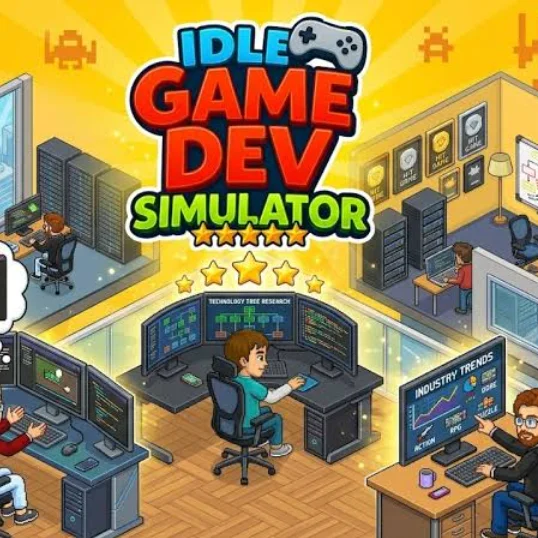













About Idle Idle GameDev
Idle Idle GameDev is an incremental management game about creating idle games while your own progress becomes increasingly automated. Begin as a solo developer with limited abilities, then turn basic ideas into completed projects that can attract players and generate money.
Each game requires several development activities. Think of ideas, write code, implement features, repair bugs, improve quality, and promote the finished product before releasing it.
Successful releases provide money, fans, skill experience, and access to more advanced systems. You can eventually employ additional workers, conduct research, activate automation, and restart through Recursion to gain permanent bonuses.
How to Play Idle Idle GameDev
- Start by selecting a development task and assigning your character’s available work capacity. Generate the ideas and code required to create your first game.
- Continue working until the project reaches an acceptable level of quality. Fix enough bugs, increase publicity when possible, and release the game to begin attracting players.
- Use the resulting money and experience to purchase upgrades. Each improvement makes future development faster and allows you to create games with larger statistics.
- Repeat the process until Recursion becomes available, then decide whether restarting in exchange for permanent progress will accelerate the next development cycle.
Controls
The browser version primarily uses the mouse:
Available shortcuts may vary between builds. The mouse can be used for all essential management actions.
Generate Game Ideas
Ideas form the beginning of a new project. Assign work to the relevant task to generate the creative resources required for development.
An ambitious game may require more ideas than a basic early project. Improve creativity-related abilities when idea generation becomes a bottleneck.
Avoid producing a huge supply without checking what the current game actually needs. Work invested in another task may provide a faster route toward release.
Write Code and Add Features
Programming transforms your concepts into functional game systems. Assign development power to code-related tasks and monitor the project’s progress.
More advanced features generally require greater programming capacity. Improve intelligence, skills, employees, and relevant research to handle larger projects efficiently.
Adding content can improve the game, but it may also introduce additional bugs. Balance feature development with the time needed to stabilize the release.
Find and Fix Bugs
Development creates bugs that can reduce the quality of your finished product. Assign work to debugging before publishing the game.
A rushed release may still generate some money, but poor quality can disappoint players and limit long-term growth.
Improve debugging speed as your games become more complex. Later projects may create bugs faster than an inexperienced developer can remove them.
Improve Game Quality
Quality influences how players respond to a release. It reflects the combined value of your ideas, features, code, and development work.
Do not judge quality as an isolated number. Compare it with fan expectations and the requirements of current challenges.
A smaller polished project may sometimes be more useful than a much larger game released before it is ready.
Build Publicity Before Release
Marketing and hype increase awareness of an upcoming game. Greater publicity can attract more initial players when the project launches.
However, excessive promotion also raises expectations. If the final quality cannot satisfy those expectations, the release may fail to convert its audience into loyal fans.
Promote the project in proportion to its quality. A balanced campaign often performs better than maximizing hype without considering the product.
Release Your Game
When development is complete, publish the project and observe how players respond. A release can generate money, fans, and other forms of progression.
Review the results instead of immediately repeating the same strategy. If the game attracted players but generated little income, research monetization or improve commercial skills. If it failed to retain users, focus on quality and playtime.
Every release provides information that can improve your next development cycle.
Attract Players and Fans
New players discover your games through publicity, reputation, and other unlocked systems. Some players may become fans when the release meets or exceeds their expectations.
Fans contribute to long-term progression and can unlock new features or challenges. A strong fan base also increases expectations for future projects.
Do not build hype faster than you can improve quality. Disappointed fans may make the next release less effective.
Generate Money
Released games earn money according to factors such as their audience, playtime, monetization, and relevant research.
Spend early income on upgrades that remove the slowest part of the development process. A general improvement may be less useful than accelerating the specific task blocking every release.
Keep enough money available for important unlocks. Spending everything on a minor upgrade can delay access to employees or research.
Improve Your Developer Skills
Performing development tasks provides experience in associated skills. Higher skill levels increase productivity and unlock bonuses.
Different attributes may affect:
- Idea generation
- Coding and features
- Debugging
- Marketing
- Player acquisition
- Monetization
- Research speed
- General work output
Build a balanced developer at first, then specialize when a particular system becomes the main obstacle.
Allocate Work Efficiently
Development power can be distributed among several tasks. Concentrating everything on one task finishes it quickly but leaves other requirements untouched.
Check which resource is preventing the project from advancing. Move workers or development capacity toward that task until the imbalance is corrected.
Revisit allocations after purchasing an upgrade. A task that was previously slow may become fast enough that another process turns into the new bottleneck.
Hire Employees
Employees add permanent working capacity during the current progression cycle. Use money from released games to hire more help.
Worker types become increasingly productive and expensive. A higher-tier employee may provide substantially more labor but require much greater investment.
Assign employees according to current priorities. Additional workers are most valuable when their effort is directed toward the task limiting overall production.
Upgrade Your Workforce
Hiring more employees is only one way to improve production. Research, skills, items, and Recursion upgrades can multiply their effectiveness.
Compare the price of the next employee with the value of an available multiplier. A production bonus affecting every worker may provide better value than one expensive hire.
Some advanced mechanics allow lower-tier employee groups to be sacrificed or retired in exchange for permanent workforce bonuses. Read the confirmation carefully before using these irreversible options.
Unlock Research
Research introduces permanent improvements and new mechanics within the current run. It becomes available after purchasing the required unlock.
Assign work to the Research task to produce Research Points. Spend those points on technologies supporting your preferred strategy.
Possible research benefits include stronger monetization, longer player engagement, faster fan growth, improved marketing, and advanced coding systems.
Select Useful Research Upgrades
Choose research according to the weakness of your studio:
- Monetization upgrades increase revenue from active players.
- Playtime improvements allow games to remain useful longer.
- Feedback and community systems support fan growth.
- Blogs and related media create additional publicity.
- Coding research unlocks development improvements.
- Marketing research strengthens player acquisition.
Do not purchase an upgrade merely because it is affordable. The best research is the one that accelerates your current objective.
Use Buffs and Items
Temporary buffs can increase work speed or skill experience. Activate them when your production is high enough to benefit from the full duration.
Permanent-for-the-run items may improve development tasks or unlock additional features. These can be more valuable than short boosts when you are still far from the next Recursion.
Avoid spending all available money on buffs if doing so delays an essential employee or research upgrade.
Complete Challenges
Challenges introduce specific requirements, such as reaching a quality target, attracting enough initial players, or creating a game under particular conditions.
Completing them provides rewards that contribute to long-term progression. Review every requirement before starting the next project.
A challenge may require a different strategy from your normal development cycle. Adjust quality, publicity, playtime, and monetization specifically for its objective.
Use Automation
Automation gradually reduces the amount of manual management required. It can repeat tasks, maintain buffs, or handle other production activities after the relevant upgrades are unlocked.
Automate repetitive actions first. This allows you to focus on research choices, project design, challenges, and Recursion timing.
Check automated allocations periodically. A setup created for an early project may be inefficient after major upgrades change production rates.
Understand Fan Expectations
Fans expect each new game to match the reputation built by previous releases. Rapidly increasing publicity can make those expectations rise faster than your development abilities.
Before releasing, compare the project’s quality with the likely expectations of its audience. Continue development if the gap appears too large.
Creative bonuses, feedback research, and other progression systems can help manage expectations during later runs.
Optimize Monetization and Playtime
A game needs players before it can generate meaningful revenue. It also benefits from retaining those players for a longer period.
Research related to advertising, transactions, procedural content, or player engagement can improve these statistics. The exact names and values may vary with the current version.
Balance income systems with quality and fan satisfaction. A profitable game that disappoints its audience may slow long-term progression.
Use Recursion
Recursion is the game’s prestige system. It restarts much of your current progress in exchange for points or bonuses that improve future runs.
The best time to recurse is usually when current development has slowed significantly and the expected permanent reward will noticeably accelerate the next cycle.
Do not reset immediately after the feature appears. Finish any nearby challenge or important unlock first if it can increase the number of Recursion Points earned.
Spend Recursion Points
Recursion Points can improve fundamental systems such as work speed, employee strength, automation, skills, and other permanent bonuses.
Prioritize upgrades that affect several parts of the game. A broad multiplier often provides greater early value than a specialized bonus used only occasionally.
Later recursions can focus on specific bottlenecks once the general production foundation is strong.
Beginner Tips
Use these tips during the first development cycles:
- Follow the introductory objectives.
- Check project requirements before assigning work.
- Focus on the slowest development task.
- Fix bugs before releasing important games.
- Keep publicity proportional to quality.
- Reinvest early income into productive upgrades.
- Hire employees when their output justifies the cost.
- Unlock research as soon as it becomes affordable.
- Select research that addresses a real bottleneck.
- Complete accessible challenges.
- Use temporary buffs during productive periods.
- Rebalance employees after buying upgrades.
- Avoid raising fan expectations unnecessarily.
- Wait for a meaningful Recursion reward before resetting.
- Read confirmation messages before sacrificing employees or progress.
Early decisions do not need to be perfect. The prestige system allows each new run to become faster.
Advanced Strategies
Develop games for different purposes. One release may prioritize revenue, another may focus on gaining fans, and a third may be designed specifically to complete a challenge.
Measure production as a complete cycle rather than improving a single impressive statistic. Generating code instantly provides little benefit if ideas or debugging still require several minutes.
Stack permanent multipliers before activating temporary speed bonuses. Multiplicative systems generally become more valuable when used together.
Plan Recursion around milestones. Reaching a new research level or permanent upgrade before resetting may substantially improve the next run.
Common Mistakes to Avoid
Avoid these common management errors:
- Generating resources without checking project requirements
- Releasing games with excessive bugs
- Creating more hype than the game’s quality can support
- Buying upgrades unrelated to the current bottleneck
- Ignoring Research Points
- Hiring workers without assigning them effectively
- Activating buffs during low production
- Forgetting to rebalance work after an upgrade
- Attempting every challenge with the same strategy
- Resetting for an insignificant Recursion reward
- Sacrificing employees without reading the consequences
- Leaving browser progress without verifying that the save has updated
Efficient progress comes from understanding how the systems affect one another.
Offline and Idle Progress
As an idle game, production can continue with limited direct input once enough automation has been unlocked. The exact amount of offline progress depends on the current browser build and available upgrades.
Before leaving the game, confirm that important tasks have workers assigned and that automation is targeting the correct resources.
Return periodically to purchase upgrades, publish finished projects, and redirect production toward new objectives.
Main Features
Idle Idle GameDev includes:
- Incremental game-development simulation
- Games created inside an idle game
- Idea generation and programming
- Feature development
- Bug fixing and quality management
- Marketing and publicity
- Players, fans, and expectations
- Game releases and revenue
- Developer skills and attributes
- Hireable employees
- Research Points and technologies
- Temporary buffs and persistent items
- Challenges and unlockable mechanics
- Automation systems
- Recursion-based prestige
- Large-number progression
- Mouse-driven browser controls
Frequently Asked Questions
What is Idle Idle GameDev?
Idle Idle GameDev is an incremental simulation in which you create, market, and release idle games while automating the development process.
Who developed Idle Idle GameDev?
The game was developed by Lutz Schönfelder under the name LutsGames.
Can I play Idle Idle GameDev online?
Yes. Its web version can be played through a compatible desktop browser.
Is Idle Idle GameDev free?
Yes. The browser version is available to play for free.
How do I make a game?
Generate ideas, write code, add features, fix bugs, improve quality, build publicity, and then release the project.
What do employees do?
Employees add work capacity that can accelerate different development tasks.
How do I unlock research?
Purchase the Research unlock when it becomes available, assign work to the Research task, and spend the resulting Research Points.
What are fans used for?
Fans support progression, increase the audience for future releases, and contribute to unlocking advanced features.
What is Recursion?
Recursion is a prestige mechanic that resets much of the current run in exchange for permanent bonuses.
When should I use Recursion?
Recurse when current progress has become slow and the displayed reward is large enough to make the next run noticeably faster.
Does the game save browser progress?
Supported versions save progress locally or through the portal’s system. Browser-data removal or private browsing may affect local saves, so use export or account options when available.
Does the browser version require a download?
No separate installation is required to play the supported web version.
Similar Games
Players who enjoy Idle Idle GameDev may also like Idle Startup Tycoon, which focuses on building technology businesses through incremental upgrades.
Other suitable internal-link recommendations include Idle Restaurants Tycoon, Idle Mining Empire, Idle Miner, Idle Bee Factory, and Money Clicker.
Final Thoughts
Idle Idle GameDev offers a clever incremental experience built around the process of creating other incremental games. Every project requires you to balance ideas, coding, debugging, quality, marketing, monetization, and audience expectations.
Identify the slowest development task, invest in useful employees and research, and avoid releasing projects that cannot satisfy their fans. When progress slows, use Recursion to begin again with stronger permanent bonuses and build an increasingly efficient game studio.
More Games Like This
CSGO Clicker

Doggo Clicker

Kiwi Clicker

Particle Clicker

Idle Restaurants Tycoon

Idle Mining Empire

Idle Digging Tycoon

Idle Startup Tycoon

Idle Gold Miner

Idle Miner

Idle Mining